

A short story
The Woman Who Pretended to Be Happy for Five Years
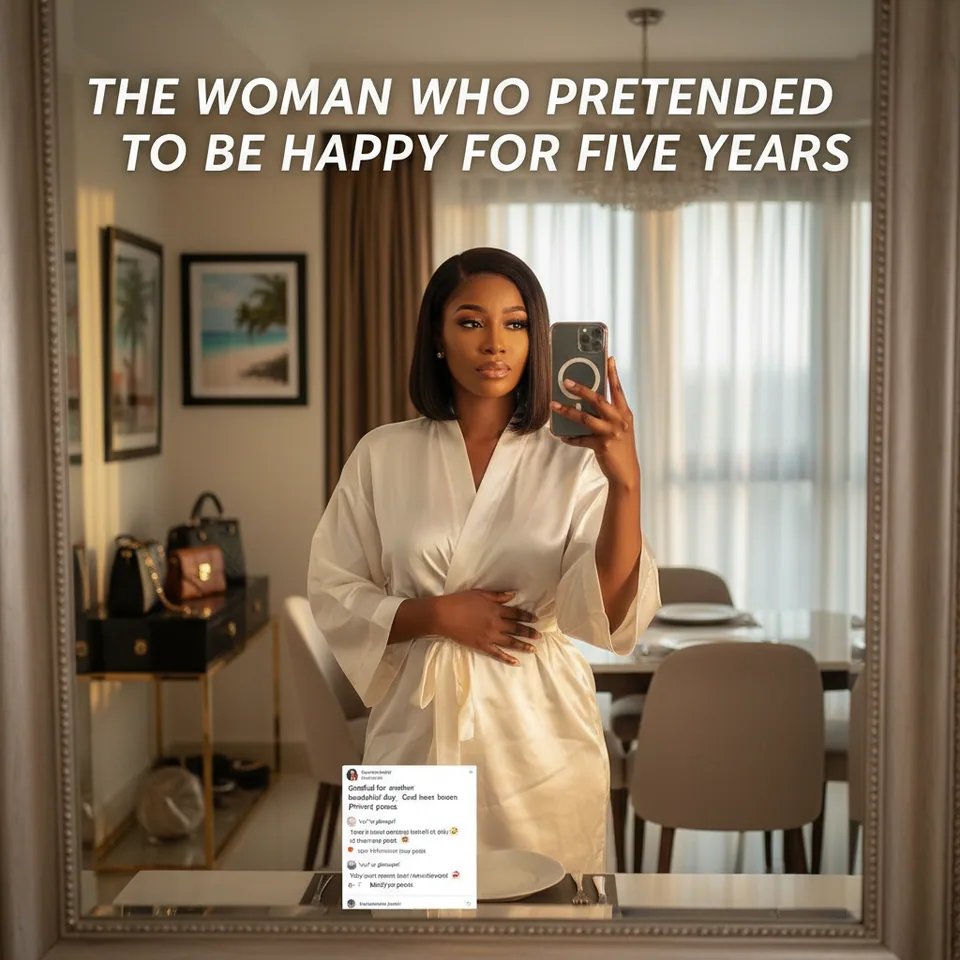
Every morning at exactly 6:30 AM, Mrs. Richardson stood before the mirror, smiling at her reflection, looking like a woman whose life made sense. This ritual had become muscle memory: tilt the chin, relax the shoulders, and smile with the eyes, but not in a way that seemed too much, because "too much" meant fake.
Of course she knew, because she'd spent five years becoming an expert at pretending.
By 7:00 AM, she'd post something cheerful like "Grateful for another beautiful day." "God has been faithful." "Protect your peace." As usual, hundreds of likes followed. As well as comments such as: "You're glowing!" "I love your energy." "Relationship goals." "You inspire me." "God, when?”
She often replied with heart emojis while sitting alone at the dining table that had six chairs with only one person eating breakfast.
Now, to the world, she had everything—an apartment in Lekki, a thriving beauty care business, a husband who drove an expensive car, vacation photos from Zanzibar, designer handbags, Sunday couple pictures, and anniversary dinners.
You know, the kind of life people would typically screenshot for vision boards, but no one noticed that in every couple photo, there was a tiny space between her and her husband, Richardson.
It was just enough room for loneliness to fit. People oftentimes assumed marriages ended with shouting, cheating, bruises, or slammed doors after a fight, but they never imagined one could end silently like a candle that runs out of wax.
Her husband wasn't cruel. No, not at all, because that almost would’ve made it worse. He was the type to remember birthdays; he paid the bills on time; he bought her expensive gifts whenever he traveled; and he’d always ask if she'd eaten.
But he hadn't looked at her—like, not truly looked at her—in years. They simply became better at managing the company called “Marriage.”
Everything worked except love.
The first year, she blamed stress; the second year, work; then the third year, she blamed herself. Maybe she'd gained weight, maybe she talked too much, or maybe she wasn't exciting anymore.
Maybe...
Women were experts at turning someone else's neglect into evidence against themselves.
So she tried harder by cooking elaborate dinners, wearing perfume to bed, suggesting weekend trips, buying new dresses, laughing louder, smiling brighter, and loving harder.
Despite the endless trials, nothing changed. That’s because you cannot make someone see you if they don’t.
One Friday evening, while cleaning the guest room, she found an old cardboard box. Inside were photographs from their courtship. They were at Tarkwa Bay, laughing, holding hands, and looking at each other as though no one else existed.
She stared at one picture for almost an hour because she missed the younger version of herself. The woman in the photograph believed love, once found, stayed. She didn't know love needed feeding, attention, curiosity, and presence. For all she knew, the picture captured two strangers, not because they had changed, but because they had stopped meeting each other right where the change happened.
That night she finally decided to ask him a question.
"Are you happy?"
He looked up from his laptop.
"What kind of question is that?"
"A simple one," she shot back.
He shrugged.
"I guess."
Then he returned to typing. She realized something devastating—he hadn't asked her the same question.
The art of pretending became more burdensome after that. Friends envied her marriage, church members asked them to mentor newlyweds, and her younger cousins wanted relationship advice, but she smiled through every conversation like an actress who had forgotten where the lie ended and real life began.
Eventually, even she couldn't tell. However, the breaking point came on a Tuesday, and it happened in a supermarket.
The cashier looked at her and said, "You have such a peaceful face, Mrs. Richardson."
“Mercy, please,” she said, smiling. “Call me Mercy instead.”
"Sure, Mercy."
She thanked her; plus, she also realized how uncomfortable the title made her feel. She wanted her very own identity, rather than remain under the shadow of a man who merely acknowledged her existence. After walking to her car, she closed the door and cried so hard she couldn't breathe.
Five years of swallowed tears escaped in a parking lot where no one knew her name. You see, sometimes the strongest people don't collapse where everyone else can see them. They wait until they're somewhere unknown.
When she eventually got home, she didn't make dinner, didn't force a conversation, and didn't post any inspirational quotes. She just sat on the balcony and listened to the noise around her. And for the first time in years, she allowed herself one dangerous thought.
What if I'm not okay?
It sounded like a minor question, but it wasn’t. It was the beginning of every honest life. The ability to admit that something hurts, giving oneself the freedom to stop performing happiness and to disappoint people who only loved the version of you that never complained.
Three months later, people began to talk amongst one another.
"She's changed."
They were right. She laughed less at things that weren't funny and said "no" unapologetically. She stopped posting perfect pictures, started therapy, and before you know it, she and Richardson finally had the conversations they'd avoided for years. Every one of them was more honest than the previous five years combined.
Whether their marriage survived was no longer the only question that mattered. The most important one was whether she would. People often think pretending protects them from pain, but it really doesn't. It simply postpones it, thereby allowing it to grow in places joy used to live.
The woman who spent five years pretending to be happy became brave the day she stopped fake-smiling, because the first act of healing is finally telling the truth about your sadness.

 The End




Comments
No comments yet.
Be the first to say what stayed with you. Anonymous is fine.